This page is a draft and may contain incorrect information and/or experimental styling.
Morimura Brothers and the Nippon Era
Table of Contents
Among the many names associated with antique Japanese export porcelain, none is more influential than Morimura Brothers (Morimura-gumi). Founded in 1876 by brothers Ichizaemon Morimura (1839–1919) and Toyo Morimura (1856–1921), the company became one of Japan's most successful exporters of fine porcelain, ceramics, and decorative arts to the United States and Europe. Their commitment to quality, artistic excellence, and international marketing helped establish Japanese porcelain as one of the defining luxury imports of the late nineteenth and early twentieth centuries.
Collectors today frequently associate Morimura Brothers with the celebrated Nippon era (approximately 1891–1921), during which beautifully hand-painted porcelain bearing the word *Nippon* entered Western markets in enormous variety. While the term Nippon is often used as though it refers to a single manufacturer, it actually describes a broader period of Japanese export porcelain. Morimura Brothers became its best-known ambassador and laid the foundation for what would later become the internationally recognized Noritake Company.
Following the Meiji Restoration of 1868, Japan actively sought international trade opportunities. Recognizing growing Western demand for Japanese decorative arts, Ichizaemon Morimura established Morimura Brothers in Tokyo in 1876. His younger brother, Toyo Morimura, soon joined the enterprise.
Rather than manufacturing porcelain themselves, the brothers created an export business that worked closely with Japan's finest ceramic producers and decorating studios. Their role was to commission wares, maintain rigorous quality standards, and market finished products abroad, particularly in the United States.
To strengthen their American presence, the company established offices in New York, allowing it to better understand Western tastes and build relationships with retailers throughout North America.
One of the most common misunderstandings among collectors is that Nippon was a company.
It was not.
"Nippon" is simply the Japanese word for Japan and appeared on export wares because of the McKinley Tariff Act of 1890, which required imported merchandise to identify its country of origin. Beginning in approximately 1891, porcelain exported to the United States was commonly marked Nippon.
Collectors now use the phrase Nippon Era to describe this remarkable period of artistic production, roughly spanning 1891 to 1921. During those three decades, numerous manufacturers produced porcelain bearing Nippon marks. Morimura Brothers was among the largest and most influential export firms, but many other companies also participated in this flourishing industry.
When U.S. Customs regulations changed in 1921, exporters replaced the word *Nippon* with Japan, effectively marking the end of what collectors now recognize as the Nippon era.
Morimura Brothers distinguished themselves by emphasizing quality over quantity. The firm commissioned porcelain from respected manufacturers and employed highly skilled decorating studios to produce wares that appealed to affluent Western consumers.
Their porcelain became known for:
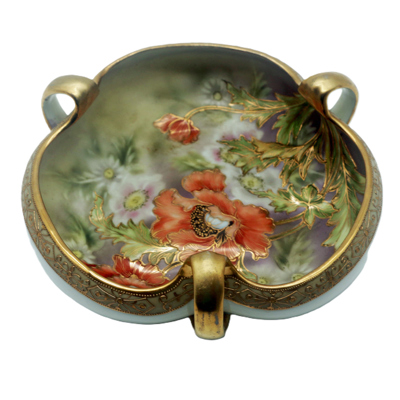
* Finely hand-painted floral decoration
* Richly blended backgrounds
* Extensive hand-applied gilding
* Raised and jeweled gold ornament
* Elegant cabinet forms
* Consistently high firing quality
* Sophisticated Art Nouveau and early twentieth-century designs
The result was porcelain that appeared luxurious while remaining attainable for an expanding middle and upper-middle class.
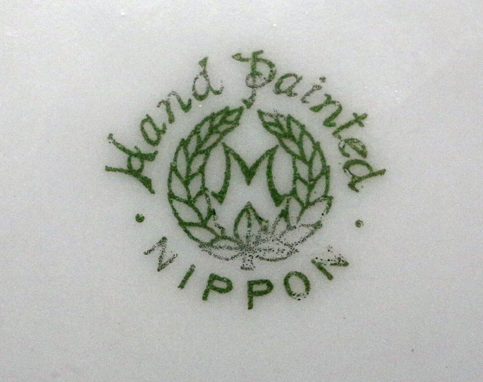
Among the most recognizable marks associated with Morimura exports is the green Hand Painted Nippon wreath mark, found on many cabinet pieces produced during the early twentieth century.
Although numerous Nippon backstamps exist, this mark has become one of the most familiar to collectors because it appears on a wide range of finely decorated porcelain exported through the Morimura organization.
Today, collectors often regard pieces bearing this mark as representative examples of the artistic quality achieved during the height of Japanese export porcelain production.
The success of Morimura Brothers eventually led the company beyond exporting decorated porcelain.
Seeking greater control over production, the Morimura family established a modern porcelain factory near the village of Noritake, outside Nagoya. After years of experimentation, the company began producing fine Western-style dinnerware under the Noritake name.
Noritake would become one of the world's most respected porcelain manufacturers, but its reputation was built upon the international relationships, quality standards, and artistic traditions first established by Morimura Brothers during the Nippon era.
Collectors continue to seek porcelain associated with Morimura Brothers because it represents one of the highest standards achieved during the Nippon period.
Particularly desirable characteristics include:
* Exceptional hand painting
* Elaborate gilding
* Floral and landscape decoration
* Unusual cabinet forms
* Distinctive handles and molded shapes
* Original Morimura-associated backstamps
* Excellent condition
Trefoil dishes, cabinet plates, vases, chocolate pots, and dresser accessories remain especially popular with collectors because they showcase the artistic freedom and decorative richness that defined the period.
Morimura Brothers helped transform Japanese porcelain from a regional craft into an internationally admired luxury product. Their insistence on quality, artistic excellence, and thoughtful marketing elevated Japanese ceramics in the eyes of Western consumers and paved the way for the global success of Noritake.
Although the word Nippon appears on countless pieces of antique porcelain, collectors should remember that it is primarily a country-of-origin designation rather than the name of a manufacturer. Understanding the role played by Morimura Brothers provides valuable context for appreciating why so many Nippon-marked wares remain among the most admired and collectible examples of early twentieth-century Japanese decorative arts.
* David Spain, *Noritake: Jewel of the Orient*.
* Joan F. Van Patten Gaston, *The Guide to Nippon Porcelain*.
* Warren H. Cox, *The Book of Nippon*.
* Noritake Company archives and historical publications.
* Meiji and Taishō period export records.
Last modified by
Admin
•8/2/2026 12:41:06 PM